Proof Positive: A British Kitchen Guide to Bulgarian Easter Bread
There are two Easters in Britain most years, and if you are Bulgarian in the UK, you probably know the feeling: the supermarket shelves are already thinking about summer by the time your family is dyeing red eggs. In 2026 Western Easter falls on 5 April and Orthodox Easter on 12 April. That week-long gap can feel awkward if you are juggling school holidays, work rotas and a British partner who thought Easter was done and dusted. Treat it as a feature, not a bug. It gives you time to bake, to breathe and to make a proper Bulgarian Easter table without turning the kitchen into a stress zone.
The date gap is not a crisis
For mixed Bulgarian-British households, the two dates can actually be a gift. You can mark the Western weekend with a quiet family lunch, a chocolate egg hunt or whatever the children have been promised, then save the Bulgarian Easter cooking for the following Sunday. If you are hosting both sides, you do not need two full productions. Pick one anchor dish for each weekend, keep the rest simple, and tell people plainly what is happening. Most guests are delighted to be fed twice. The only real rule is not to exhaust yourself trying to prove a point about tradition.
What kozunak actually needs from a British kitchen
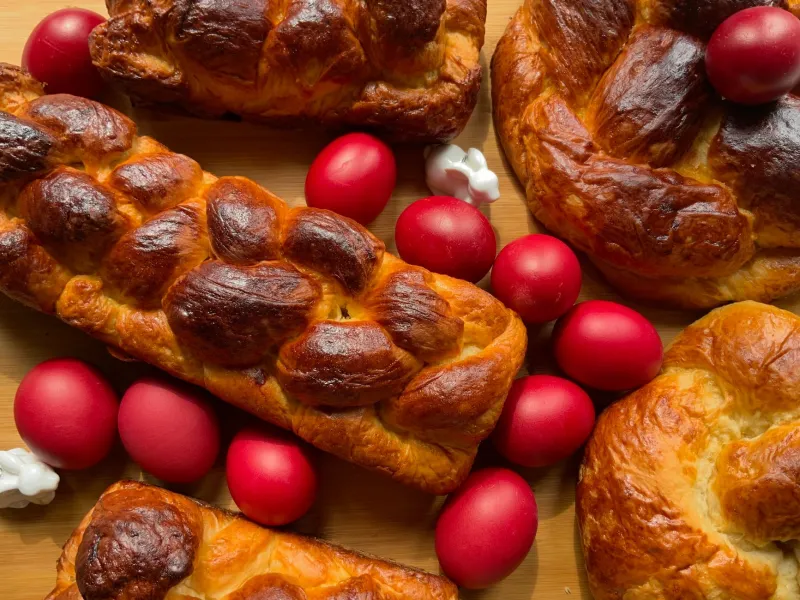
Kozunak is a rich, sweet, braided bread, somewhere between brioche and a very generous tea loaf. It is not a plain loaf with raisins thrown in. The dough wants butter, eggs, milk, sugar and time. In Britain, the biggest practical hurdles are flour strength and room temperature.
Start with strong white bread flour, not plain flour. Look for a protein content around 12 per cent, which is common in British bread flours. If you are shopping in a Polish, Turkish or Bulgarian shop, ask for fresh yeast if you like using it, but instant dried yeast is perfectly reliable and easier to keep in a British kitchen cupboard. Full-fat milk and real butter make a difference. Do not try to slim the recipe down on your first attempt. Kozunak is not the moment for a lighter alternative.
Raisins can be soaked in tea, rum or orange juice while the dough proves. Lemon or orange zest, vanilla and a pinch of salt keep the flavour from becoming one-note sweet. Some families add mahleb or a little mastika, but you do not need a specialist ingredient list to make a good version at home.
Slow is your friend
Enriched dough is heavy, and heavy dough rises slowly. British kitchens can be draughty, especially in April. Mix and knead until the dough is smooth and elastic, then leave it somewhere genuinely warm. A bowl of hot water in a closed oven, with the door shut and the oven off, works well. So does a sunny windowsill on a good day.
Let the dough double in size. Depending on your kitchen, that could take an hour and a half or closer to three. Do not rush it by adding more yeast. The flavour develops while the dough sits. Once it has risen, knock it back gently, divide it into strands and give it a short rest before you start braiding. This rest makes the dough easier to handle and less likely to spring back.
Braiding without panic
You do not need a bakery-level plait. Divide the dough into three or four equal pieces, roll each into a long log, pinch the tops together and braid loosely. Tuck the ends underneath and place the loaf in a lined tin or on a baking tray. A loose braid gives the bread room to rise. A tight one can look neat before baking and then split in a slightly dramatic way.
For a British oven, use an oven thermometer if you have one. Fan ovens run hot. Bake at around 170C fan, checking after twenty-five minutes. If the top is browning too quickly, cover it loosely with foil. The loaf is done when it sounds hollow underneath and feels firm at the centre. Let it cool before slicing, if you can manage it. Kozunak straight from the oven is hard to resist, but a little patience makes it easier to cut.
Red eggs and small hands
Dyeing eggs with children is one of the most joyful parts of Bulgarian Easter, and it does not need to be perfect. The first egg is traditionally red, a colour tied to health and luck. You can use onion skins for a deep rust colour, or food colouring with a splash of vinegar. Cover the table, wear old clothes and accept that a few cracked eggs are part of the process. Children remember the mess and the laughter more than the finish.
Keep the first red egg somewhere safe if that is your family custom. In many Bulgarian homes it stays until the following year. If you are not sure about the details, ask an older relative on a video call. These small conversations are often as much a part of the tradition as the egg itself.
Finding a local Orthodox church
For many families, Easter is not only about food. If you want to attend an Orthodox service in 2026, search for a Bulgarian Orthodox parish near you, or look for a pan-Orthodox church that serves the Bulgarian community. London has a well-known Bulgarian church, and other UK cities have Orthodox parishes that welcome visitors. Call or email ahead, especially if you are bringing children, and ask about service times and language. Easter services can be long, so a little planning helps.
The mixed Easter table
A Bulgarian Easter table usually includes kozunak, red eggs, roast lamb, a fresh salad and something sharp to cut through the richness, such as radishes or spring onions. A British table might bring mint sauce, hot cross buns or a Sunday roast mentality. You do not have to choose. Put kozunak next to hot cross buns and let people try both. Serve the lamb with whatever your family likes. Add shopska salad, a bowl of lettuce and a plate of red eggs. If you are short on time, buy the salad and focus your energy on the bread.
Bake kozunak on the Saturday if you can. It keeps well for a few days and freezes in slices. That means you can have a Bulgarian Easter Sunday and still produce something respectable for a British bank holiday brunch. Sabor means flavour, but it also means the feeling around a table. The point is not a perfect bake. The point is that someone tore off a piece of bread, someone cracked a red egg, and everyone found a chair.
A final proof
If your first kozunak is a little dense, a little pale or slightly lopsided, call it a learning loaf and eat it anyway. British kitchens are not Bulgarian kitchens, and your Easter does not need to look like a photograph. It needs to taste like home, or like the beginning of one. Start the dough early, keep the braid loose, dye an egg with a child, and leave room at the table for both calendars.